2025 August Digest

Here's my 2025 August reading digest
Interview with Rhonda Patrick on Health
This interview synthesizes key insights on aging, healthspan, and cognitive performance from an in-depth discussion with Dr. Rhonda Patrick, a biomedical scientist. The central thesis is that:
lifestyle choices, not genetics, are the primary determinant of aging outcomes, accounting for approximately 70% of the aging process.*
The conversation highlights a significant knowledge gap between established scientific findings and public awareness, emphasizing simple, actionable interventions that can drastically improve both lifespan and "healthspan"—the period of life spent in good health, free from disease.
Key Takeaways
- The profound impact of exercise, particularly vigorous-intensity training, which can reverse age-related structural changes in the heart and brain.
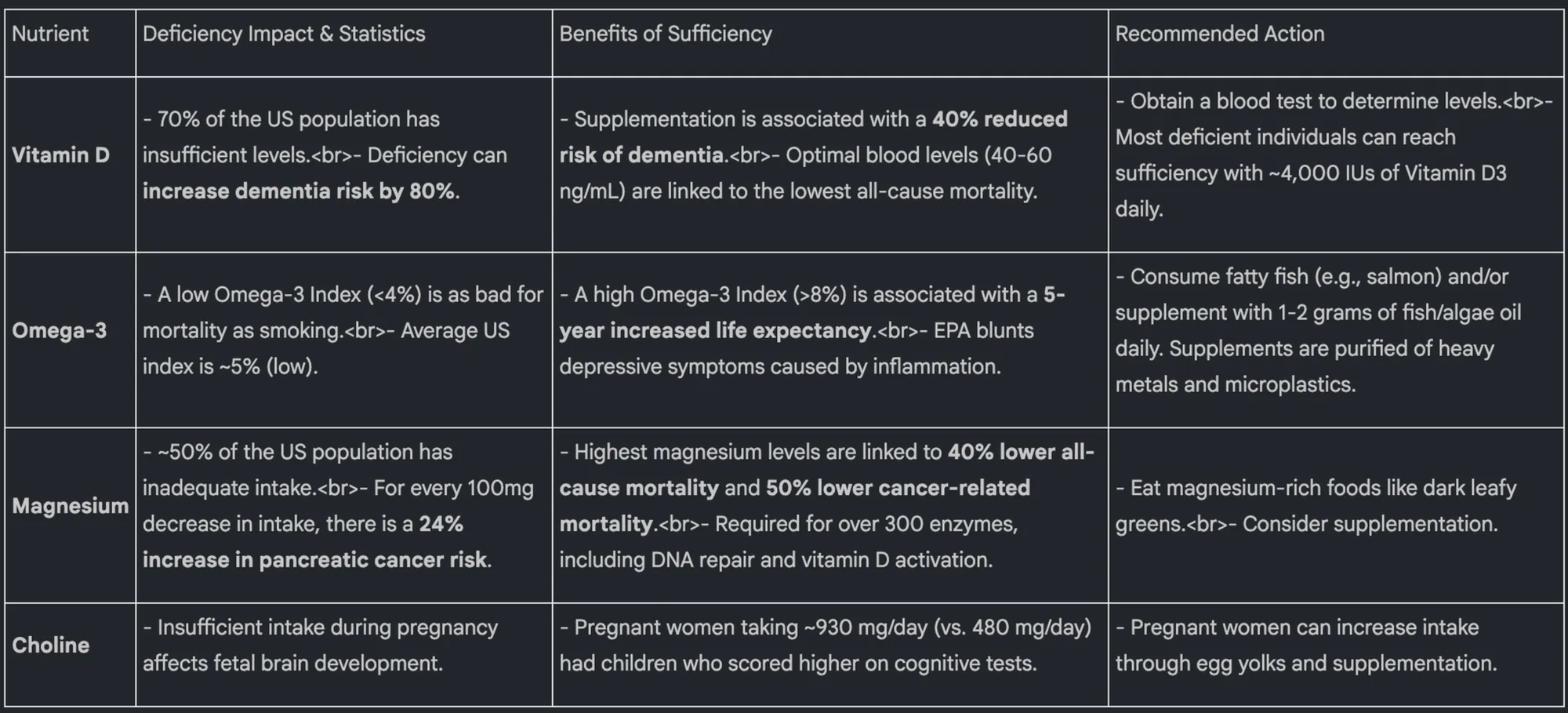
- Specific micronutrient deficiencies are identified as major risk factors for disease, with low omega-3 levels being as detrimental to mortality as smoking, and vitamin D deficiency increasing dementia risk by up to 80%.
- She details the cognitive and physical benefits of supplements like creatine and magnesium
- She explores the mechanisms behind dietary strategies such as the ketogenic diet and intermittent fasting.
- Finally, it touches on emerging technologies like cellular reprogramming and environmental factors that influence long-term health.
The Controllability of Aging: Lifestyle Over Genetics
A core argument presented is that the common perception of aging as an inevitable, genetically-predetermined decline is inaccurate. Scientific evidence suggests lifestyle is the dominant factor.
- Lifestyle's Dominance: Approximately 70% or more of the way an individual ages is attributed to lifestyle choices, with genetics playing a smaller role. This control empowers individuals to dramatically influence their aging trajectory.
- Healthspan vs. Lifespan: The focus is not merely on extending life (lifespan) but on extending the period of functional independence, cognitive sharpness, and overall well-being (healthspan).
The Primacy of Exercise
Exercise is positioned as the single most powerful intervention for healthspan and longevity, so effective that if its benefits could be encapsulated in a pill, "it would be the biggest blockbuster miracle drug out there.”
- Sedentary Lifestyle as a Disease: A sedentary lifestyle is not merely a lack of activity but an independent disease state. Its risk for early mortality has been shown to be even greater than that of type 2 diabetes, cardiovascular disease, or smoking (The Dallas Bed Rest Study).
- Cardiorespiratory Fitness (VO2 Max) as a Longevity Predictor: VO2 max—the maximum amount of oxygen the body can utilize during intense exercise—is one of the strongest predictors of longevity. Individuals with high cardiorespiratory fitness live, on average, five years longer than those with low fitness. They are 80% less likely to die from major causes like cardiovascular disease, cancer, and respiratory disease.
- The Functional Cliff: As VO2 max naturally declines with age, daily activities (e.g., carrying groceries, which requires ~11 mL/kg/min of oxygen) become maximal efforts, leading to a loss of independence. Improving fitness pushes this "cliff" further away.
Vigorous Intensity Exercise: The Gold Standard
While any movement is beneficial, vigorous-intensity exercise is uniquely effective for improving VO2 max. This is defined as exercise where conversation is not possible, reaching ~80% of max heart rate.
- Inefficiency of Moderate Exercise: Studies show that up to
40%of people engaging in2.5hours of moderate-intensity exercise per week (e.g., Stairmaster) fail to improve their VO2 max. - High-Intensity Interval Training (HIIT): The stronger stress from HIIT elicits greater cardiovascular adaptations. Recommended protocols include:
- Norwegian 4x4 (Gold Standard): 4 minutes of high-intensity effort, followed by 4 minutes of light recovery, repeated 4 times. Best performed on a stationary bike or rowing machine.
- 1-Minute On, 1-Minute Off: 1 minute of hard effort followed by 1 minute of rest, repeated 10 times (20-minute workout).
- Tabata: 20 seconds of all-out effort, followed by 10 seconds of rest, repeated 8 times.
- Minimum Effective Dose: One HIIT session per week is considered the minimum effective dose for seeing benefits.
Physiological Benefits of Vigorous Exercise: The impacts of intense exercise are systemic, affecting the heart, brain, and cellular communication. A study by Dr. Ben Levine demonstrated that a two-year, progressive exercise program (5-6 hours/week, including 1-2 sessions of Norwegian 4x4) in sedentary 50-year-olds reversed the structural aging of their hearts by 20 years. The participants' hearts became larger and less stiff, resembling those of 30-year-olds. This counteracts the stiffening caused by glycation from high glucose levels.
Lactate: The "Miracle Molecule": During intense exercise, muscles produce lactate. Far from being a mere waste product, lactate is a crucial signaling molecule. It travels to the brain, heart, and liver to be used as a high-efficiency energy source. In the brain, it activates Brain-Derived Neurotrophic Factor (BDNF), which is described as "Miracle-Gro for your brain." BDNF promotes neurogenesis (growth of new neurons), enhances neuroplasticity, and improves memory and cognition. It also increases neurotransmitters like norepinephrine (focus) and serotonin (mood, impulse control).
Exercise and Brain Health: Exercise is a cornerstone of preventing cognitive decline. The hippocampus, a key area for learning and memory, naturally shrinks by 1-2% per year starting in midlife. A study on older adults (60+) showed that a one-year aerobic exercise program not only halted this shrinkage but caused the hippocampus to grow by 1-2%. This demonstrates that it's "never too late" to benefit. Women with the highest cardiorespiratory fitness were found to be 80% less likely to develop dementia over a long-term follow-up period.
Nutritional Science for Longevity and Cognition
Specific micronutrient deficiencies and dietary patterns have an outsized impact on long-term health, often equivalent to known toxins or risk factors.
Creatine: Beyond Muscle Building
Previously dismissed as a supplement for "gym bros," creatine is now recognized for its significant benefits for brain health, especially under conditions of stress. The brain is a high-energy-demand organ. Creatine helps regenerate ATP (the cellular energy currency) more quickly, improving brain function under stress.
While 5g/day is effective for saturating muscles, studies suggest 10g/day or more is needed for excess creatine to "spill over" and significantly increase levels in the brain. Doses of 25-30g have been shown to completely negate the cognitive deficits of 21 hours of sleep deprivation, with subjects performing better than when well-rested. Reduces mid-afternoon energy crashes and enhances focus during cognitively demanding tasks. arly research shows promise in improving depression symptoms (when combined with CBT) and cognition in Alzheimer's patients.
Ketogenic Diet and Ketones
A ketogenic state, achieved through diet, fasting, or intense exercise, offers unique benefits for the brain. Mechanism: When carbohydrate intake is very low, the body produces ketone bodies, primarily beta-hydroxybutyrate (BHB), from fat. Neurons can use BHB for energy more efficiently than glucose. By using BHB, neurons spare glucose, which is then shunted into a pathway that produces glutathione, the brain's master antioxidant. Like lactate, BHB is a signaling molecule that activates BDNF, promoting neurogenesis and neuroplasticity.
Understanding and Preventing Dementia
Dementia is a multifactorial disease, but many of its underlying causes can be mitigated by lifestyle choices. Primary cause:
- Amyloid Plaques: Aggregates of protein that disrupt synaptic connections between neurons.
- Glucose Metabolism Disruption: The brain's inability to effectively use glucose for energy, sometimes called "type 3 diabetes."
- Neuroinflammation: A major driver of brain aging and neurodegeneration.
- Genetics (APOE4): The APOE4 gene is a major risk factor. One copy doubles the risk of Alzheimer's; two copies increase it tenfold. For carriers, lifestyle factors become even more critical.
The Role of Sleep: The brain's glymphatic system, which clears metabolic waste like amyloid, is primarily active during deep sleep. Chronic poor sleep is a major risk factor for Alzheimer's. A large, randomized controlled trial found that taking a simple daily multivitamin (Centrum Silver) for several years improved cognition in older adults, with an effect equivalent to reducing the aging of episodic memory by five years.
Other Lifestyle Interventions & Environmental Factors
Sauna Use (Deliberate Heat Exposure)
Traditional hot saunas (175-180°F) offer significant health benefits by mimicking moderate-intensity exercise. It Increases heart rate, core body temperature, and cardiac output, similar to aerobic exercise. Studies using whole-body infrared heat beds to induce a fever-like state showed a "stunning" and lasting anti-depressant effect in individuals with major depressive disorder, far exceeding the effect of a sham control. Adding a 15-minute sauna session after exercise leads to greater improvements in VO2 max, cholesterol, and blood pressure than exercise alone.
Environmental Toxin Awareness
Microplastics: Exposure is ubiquitous. Hot liquids in paper cups (which have plastic liners) or from plastic-containing tea bags dramatically accelerate the release of microplastics and chemicals like BPA/BPS. Soluble fiber may help reduce absorption by creating a viscous gel in the gut that traps particles.
Pesticides: Many pesticides are mitochondrial toxins. A 2024 study found that people living within one mile of a golf course had a 126% higher risk of Parkinson's disease, likely due to pesticide contamination of the local water supply. A high-quality water filter is recommended for those in high-risk areas.
The Future of Aging: Cellular Reprogramming
Exciting research is underway in the field of cellular rejuvenation, pioneered by Nobel laureate Shinya Yamanaka. Yamanaka Factors: Four specific proteins can revert an old, specialized cell (e.g., an 85-year-old's skin cell) back into an embryonic-like stem cell, wiping its epigenetic slate clean.
Partial Reprogramming: Scientists have discovered that "pulsing" cells with these factors for a shorter duration can make them biologically younger (e.g., a 1-year-old's skin cell) without erasing their cellular identity. This technique has rejuvenated organs in animal models and represents a promising future for reversing the aging process, though human translation is still in development.
Comments ()